
-

Managing your first season alfalfa for longevity

Learn how to manage cutting, grazing, weeds and nutrients to get 4-7+ years of performance from your stand.

In this article

Prioritising strong establishment and management over yield in the first year leads to greater total production across the life of the stand.

From crown development to carefully managed grazing and cutting, here’s how to manage young alfalfa for long-term performance.
Build the crown, build the stand

Alfalfa persistence starts below the surface. 

In its first year, alfalfa:

  • Establishes a deep taproot
  • Forms a crown from which all future shoots will grow
  • Stores energy reserves that drive regrowth and resilience

Cutting or grazing too early can damage developing crowns, reduce root growth, and lead to early plant death, even if the stand looks strong on top.

Longevity tip:

  • Dormant & semi-winter-dormant varieties can persist for 7+ years with good management
  • Winter active types typically last 5–7 years
  • Non-dormant alfalfa will often persist 3–4 years

When to graze or cut

Alfalfa should only be grazed or cut once it’s properly established and ready to recover. Key indicators:

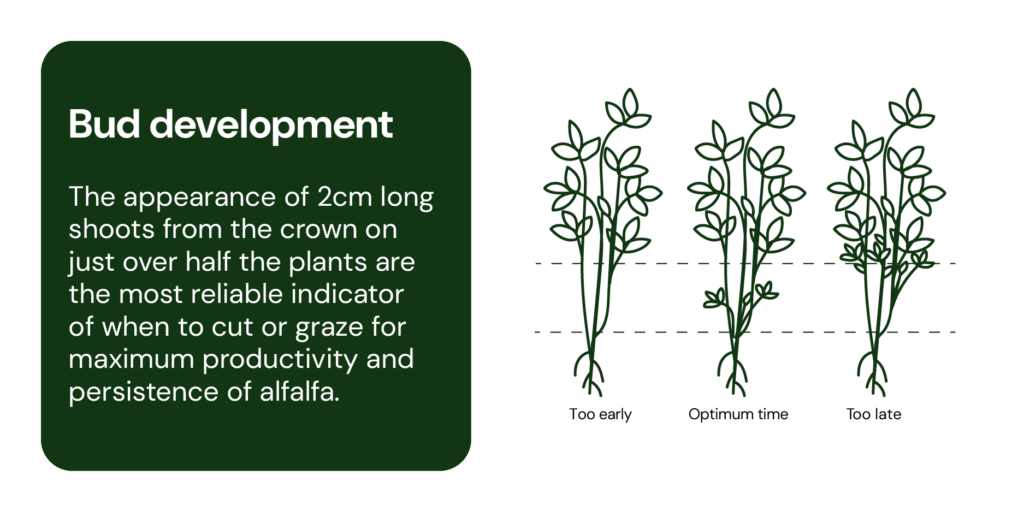
  • Shoots are 2cm long from the crown on at least 50% of plants
  • Plants are well anchored and resist pulling from the soil
  • Root nodulation is clearly visible (check a few plants)

Avoid:

  • Grazing during wet conditions (increases crown damage)
  • Grazing immature stands
  • Cutting too low or too often in year one

For maximum longevity, aim to cut at mid-bud to early flowering stage. Let it reach mid-flower before your final cut. After planting, avoid grazing or cutting until plants are at least 20cm high and well anchored. Alfalfa established under cover crops should be allowed to flower before first cut or grazing. The appearance of 2cm long shoots from the crown on just over half the plants are the most reliable indicator of when to cut or graze for maximum productivity and persistence of alfalfa.

Watch for weeds and insects early

In its first few months, alfalfa is highly susceptible to:

  • Weed competition: especially capeweed, wireweed, barley grass
  • Insect pressure: redlegged earth mite, alfalfa flea, blue green aphid

To protect your young stand:

  • Use pre-sowing knockdowns and pre-emergents (e.g. Trifluralin)
  • Monitor frequently and control early, damage often goes unnoticed until it’s too late
  • Pest and disease pressures vary by region. Get in contact with AlfaGen Seeds about which varieties offer the best resistance profile for you

Support the system with nutrients

Alfalfa removes large amounts of nutrients, even in its first year. If you don’t replace what’s lost, stand persistence suffers.

Fertility tips for establishment:

Apply starter phosphorus (P) and molybdenum at sowing to support early root development and nodulation.

After your first cut or graze, apply potassium (K) and additional phosphorus based on expected yield.

Information to remember:

Apply 6kg of P and 25kg of K for every tonne of alfalfa hay removed.

Use soil and tissue testing to fine-tune inputs, especially for potassium and sulphur. Deficiencies in these nutrients often show up too late to fix, but they reduce regrowth and persistence from the start.

Common early mistakes (to avoid)

Cutting too low and too often
Only cut once or twice in the first year, and let it flower before winter.

Grazing too early or hard
Stresses crowns before they’re ready, shortens stand life.

Skipping weed control
Alfalfa establishes slowly and is easily affected by weeds in the first season. Effective weed control is essential. 

Underfeeding
Alfalfa establishment takes a lot out of the soil. Replacing nutrients in year one is essential.

Conclusion

An alfalfa stand can give you 4-7+ years of reliable feed, or just 2. The difference often comes down to effective management during the establishment year.

Get the first season right by:

  • Grazing and cutting conservatively
  • Controlling weeds early
  • Feeding the plant for future persistence
  • Focusing more on strong establishment and management than yield

Keep your alfalfa going strong

The first year is critical, but there’s more you can do to set your stand up for success. Explore more advice from the Alfalfa Advisor Series:

  • Why tiller density matters for alfalfa persistence
  • When to cut and how to feed alfalfa for value
  • Alfalfa in rotation – how to know when it’s time

While we don’t supply seed directly to farmers, AlfaGen products are available through trusted distributors and farm supply stores. If you don’t know who your local distributor is, please reach out via the enquiry form and we can assist.